Business Agility
3D Transformation Framework.
3D Transformation Framework is a holistic model that aligns business, digital, and cultural transformation to drive sustainable growth, agility, and high performance—turning strategy into a continuous, scalable execution capability.
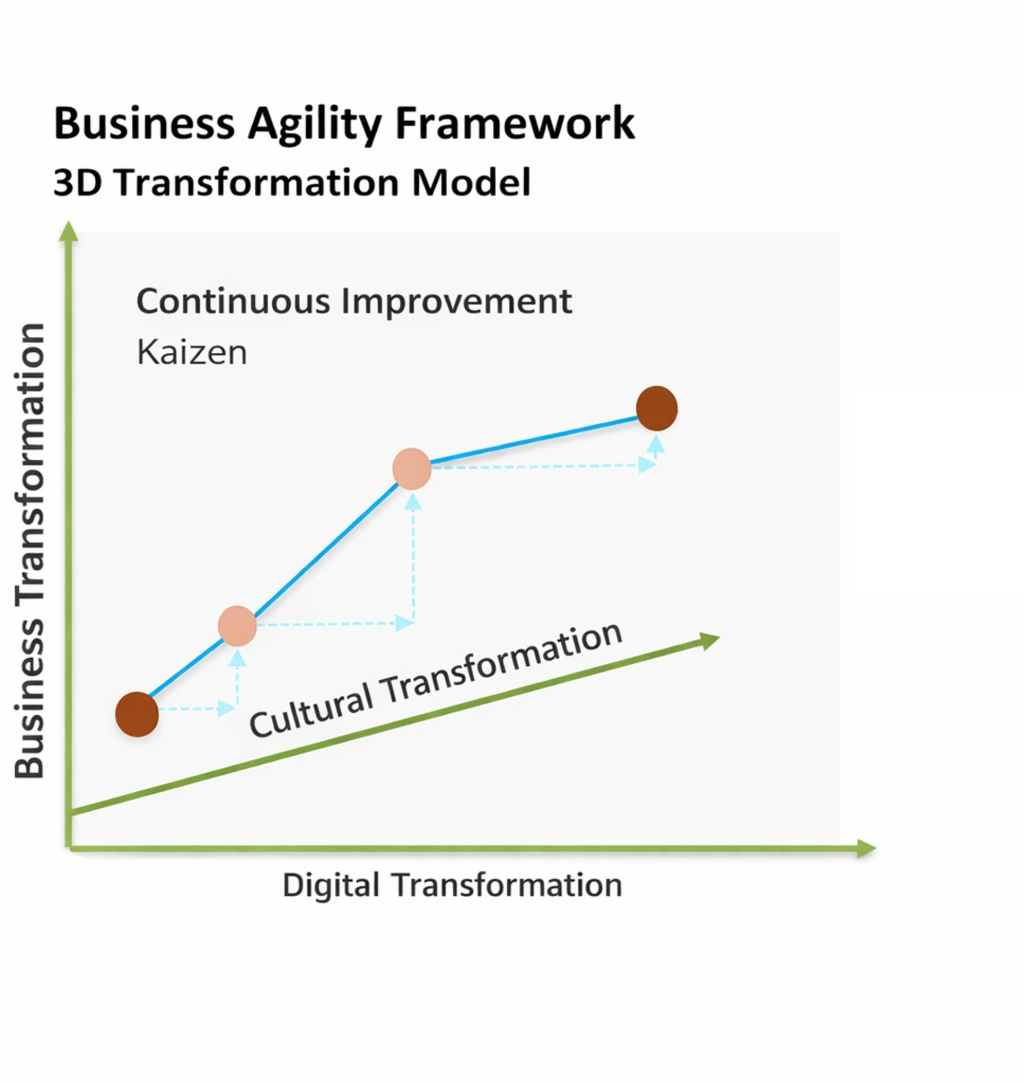
The institutionalization of the business is viable to the extent that business, technological, and cultural transformation are aligned within a maturity and continuous improvement model that drives business agility.
The 3D Transformation Framework is a structured approach designed to help organizations achieve sustainable growth by aligning three critical dimensions: business, digital, and cultural transformation.
In today’s environment, most transformation efforts fail not due to lack of strategy, but because execution is fragmented across functions, technologies, and teams. The 3D Transformation Framework addresses this gap by integrating strategy, technology, and people into a single, coordinated system.
Through a maturity-based model and continuous improvement principles, organizations can move from isolated initiatives to systemic transformation, enabling faster execution, better decision-making, and long-term adaptability.
The result is a more resilient, agile, and high-performing enterprise capable of consistently translating strategy into measurable business outcomes.
Organizations today face increasing pressure to adapt to rapidly changing markets, evolving customer expectations, and continuous technological disruption. While many invest heavily in digital initiatives or strategic planning, few succeed in achieving meaningful transformation.
The root cause is often a lack of alignment. Business strategy, digital capabilities, and organizational culture evolve independently, creating silos that limit execution and impact.
The 3D Transformation Framework was developed to address this challenge. It provides a holistic and structured methodology that connects what the organization wants to achieve (business), how it enables it (digital), and how people adopt and sustain it (culture).
Rather than treating transformation as a series of disconnected projects, the framework establishes a cohesive system for continuous evolution, supported by clear governance, measurable progress, and iterative improvement.
By adopting this approach, organizations can move beyond one-time change efforts and build a scalable capability to execute strategy effectively in any environment.
1. The Reality Check
Here are some common questions about our company.
Because they are fragmented.
Companies launch digital projects, redesign processes, or invest in culture…
but these efforts operate in isolation.
👉 The result: activity without impact..
Alignment.
Strategy, technology, and people are not moving in the same direction—
so execution breaks down.
👉 Transformation doesn’t fail at the idea level.
It fails at the system level.
2. The Shift in Thinking
Here are some common questions about our company.
They don’t transform in silos.
They integrate three dimensions:
Business
Digital
Culture
👉 And manage them as a single system.
Transformation becomes:
Faster
Scalable
Sustainable
👉 It stops being an initiative… and becomes a capability.
3. The 3D Transformation Framework
Here are some common questions about our company.
It is a structured methodology that aligns:
Business transformation
Digital transformation
Cultural transformation
Into a unified, maturity-driven model.
Most frameworks focus on one dimension.
This one ensures balance and synchronization across:
Processes
Technology
People
👉 No over-investment. No blind spots. No disconnects.
4. How It Works
Here are some common questions about our company.
Through four core stages:
1. Diagnose
Where are you today?
2. Align
Where should you go—and why?
3. Orchestrate
How do all initiatives work together?
4. Evolve
How do you sustain continuous improvement?
No.
It is built on continuous improvement (Kaizen),
so transformation becomes an ongoing capability.
5. Designed for Leadership
Here are some common questions about our company.
Because it connects:
👉 Strategy → Execution → Results
It provides:
Visibility
Control
Measurable outcomes
It turns planning into execution orchestration:
Clear roadmap
Prioritized initiatives
Cross-functional alignment
Continuous tracking
👉 From static plans to dynamic execution systems.
6. The Outcome
Faster execution
Better alignment
Higher performance
Greater adaptability
👉 A truly agile enterprise.
To build an organization that doesn’t just transform once—
but can continuously evolve and outperform.
7. Call to Action
Here are some common questions about our company.
Start with clarity.
Book an executive session to:
Diagnose your current maturity
Identify gaps and opportunities
Define your transformation path
Ready to turn strategy into execution?
👉 Book Your Executive Strategy Session
👉 Get a tailored transformation roadmap